
Lorem ipsum dolor sit amet, consectetur adipiscing elit. Ut elit tellus, luctus nec ullamcorper mattis, pulvinar dapibus leo.
How to activate a sports community in B2B?
Karl Lefranc’s method at Bundeling
We hear the word “community” constantly in sports digital marketing, but there’s an uncomfortable question behind it: how many clubs truly have a community… and how many simply repeat the word to reassure themselves? In a sector where everything revolves around belonging and self-esteem, two key levels in Maslow’s hierarchy, creating connection, telling a story, and delivering real value have become critical. So how do you move from talk to action? How do you build a sports community that feels alive, stays connected, builds loyalty, and creates opportunities for both the club and its partners? To explore these questions, I spoke with Karl Lefranc, Managing Director at Bundeling, a solution used by nearly 1,500 sport clubs and professional organisations. He shares what sets Bundeling apart, where the French market really stands today, the ingredients of a true community dynamic, a striking “before/after” case in a sports business network, and what the football club of 2030 could look like.
Can you introduce Bundeling and explain what makes the company different?
Bundeling is currently the European leader in community mobile apps. We operate across several countries, the Netherlands, Belgium, France and Germany, as well as the UK and Spain, with a multicultural team speaking up to five languages. Most of our clients are European, but because digital has no borders, we also work with organisations in the United States and Australia. A community app is a closed application built for a specific audience: an association for its members, a sports club for its partners or fans, or a company for its employees. Whenever there’s a need for internal communication, whether the community includes 10 people or 30,000, Bundeling can help. Today, we support around 1,700 client apps. We develop both long-term community apps, our core business, especially in B2B, and short-term apps for events. In professional sports, our role is to structure and energise club business networks by creating a tool that enables partners to genuinely connect with one another. We work with a wide range of organisations, from regional level to major European clubs such as Juventus, AS Roma, Borussia Dortmund and LOSC. In more than 90% of cases, our mission is the same: to design the club’s private app dedicated to its partners. This is at the heart of Bundeling’s DNA.
“Digital never replaces human relationships: it strengthens them and elevates them.”
How would you describe the maturity of the French sports digital market?
The French sports digital market is still fairly conservative, similar to Italy or Spain, especially compared with Northern European countries. People often talk about a slight digital lag, and many clubs still say that digital is “nice,” but nothing replaces meeting in person.
What we try to explain is simple: digital never replaces human relationships. It supports them, strengthens them, and elevates them. Gradually, clubs are starting to realise that bringing people together is good, but it’s no longer enough. They need tools to show partners that their investment generates real returns. A euro is still a euro, and ROI has become essential. If a tool allows partners not only to track that return but also to network, generate business and remain engaged over time, it’s a win for the club. This shift is being accelerated by today’s economic context: lower broadcast revenues, tighter budgets, reduced sponsorship and philanthropy spend, and fewer subsidies after major events such as the Rugby World Cup or the Olympic Games. Many sports organisations now have fewer resources and must do more with less, so Bundeling can become almost a vital solution. Because we serve a clearly defined B2B audience, our apps also generate high-value data that can be leveraged with existing partners or used to attract new sponsors and advertisers.
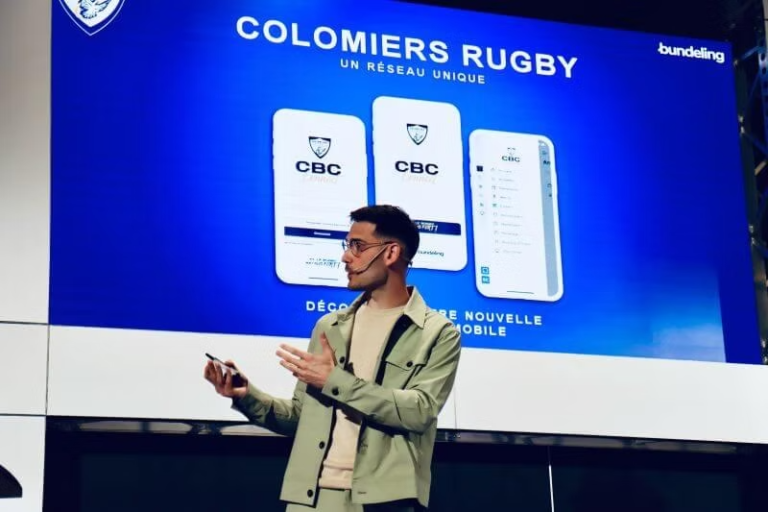
Everyone talks about “sports community.” How do you move from words to action?
The word “community” can refer to several realities. Everything starts with defining the end goal: are you focused on retention, attractiveness, saving time, monetisation? Often it’s a mix, and the actions you take depend on what you aim to achieve. Creating a community today isn’t difficult: you can launch a website or a WhatsApp group in seconds. The real challenge is activation. Launching a community is one thing; sustaining it is another, and it takes a lot of energy. Without the right tools, momentum fades quickly. An app, for example, already sends a strong signal: it shows the community exists, and that it lives in the user’s hand, available 24/7. As soon as the community starts to scale, it becomes essential, not only to identify members, but also to manage interactions and create value for everyone. And depending on whether the community is paid or free, whether it prioritises quantity or quality, whether it’s membership-based or open, the goals and sub-goals naturally shape the actions needed to turn “community” from a word into a real experience.
“The club of 2030? It’s the one that stops selling football and starts selling a community.”
A concrete example where Bundeling changed how a club’s business network works?
There are many examples at every level, but the one that best illustrates Bundeling’s impact is probably AS Saint-Étienne, where I worked and saw a real “before and after.” Like many clubs, Bochum in Germany for example, they had a business network that existed on paper but was hard to make tangible. To access it, you needed a hospitality package. You might see people once a month at an event, and at the stadium you’re not necessarily there yourself, or you only meet a portion of partners depending on which lounge you’re in. Outside of that, there wasn’t much to prove membership in the network. At the same time, communication was becoming increasingly difficult: email open rates were falling fast. Executives receive dozens of messages a day, and many get missed. Bundeling changed everything. The network became a real business network, attracting partners who were as interested in business opportunities as they were in sport, which significantly increased membership. The time savings were huge, and communication was transformed. Some clubs drastically reduced email; others removed it entirely and moved to 100% app-based communication. It’s easier for users, easier for clubs, and thanks to the support we provide before and after launch, download and usage rates remain very high, often above 90%. At Saint-Étienne and elsewhere, the contrast is striking: where tasks used to take several minutes, or required the help of an unavailable sales rep, everything is now centralised, immediate and accessible to the entire network.
What will the football club of 2030 look like in communication and partner relationships?
To picture the football club of 2030, we should first recognise that some clubs already do excellent work today. The gap isn’t about competence; it’s often about mindset. For me, the truly connected club in 2030 is the one that stops selling football and starts selling a community. When you go to the cinema or your favourite restaurant, it’s not only for the film or the meal; it’s because you have a story with that place. For a club, it’s the same: it’s storytelling. Many clubs still rely almost exclusively on sporting storytelling, but what happens when results aren’t good? Sport will always matter. But if you build a strong story and a real community around the club, like we see in the United States, even at university level where crowds can sometimes outdraw professional leagues, you create a bond that goes beyond the pitch. From there, you need to identify your goals, your fans, and especially your revenue streams: B2C, B2B, or both. B2B, in particular, will become even more essential, because major sponsors invest less and the share of SMEs will naturally increase. Despite the challenges these businesses face, they remain the beating heart of the French economy. Ultimately, the club of 2030 will be the one that understands that before dreaming of national sponsors, it must be the leader in its own city, through story, connection, identity and engagement. That foundation is what will make it strong.
Bundeling takes its name from the English verb to bundle, meaning to bring people together. It’s hard to imagine a more fitting word for both the solution and the persons behind it. Through his journey and vision, Karl Lefranc highlights something we sometimes forget in sports business: behind the technology, behind the digital, behind the data, there are always people to connect. And that may be the greatest strength of all. Bundeling’s slogan, “Connect Smarter,” takes on its full meaning here. It doesn’t just summarise a product; it captures a philosophy: technology only matters when it truly brings people closer.
This article was originally written by Simon Leon and has been translated into English by Bundeling. Our thanks to Simon Leon for the original piece.
